
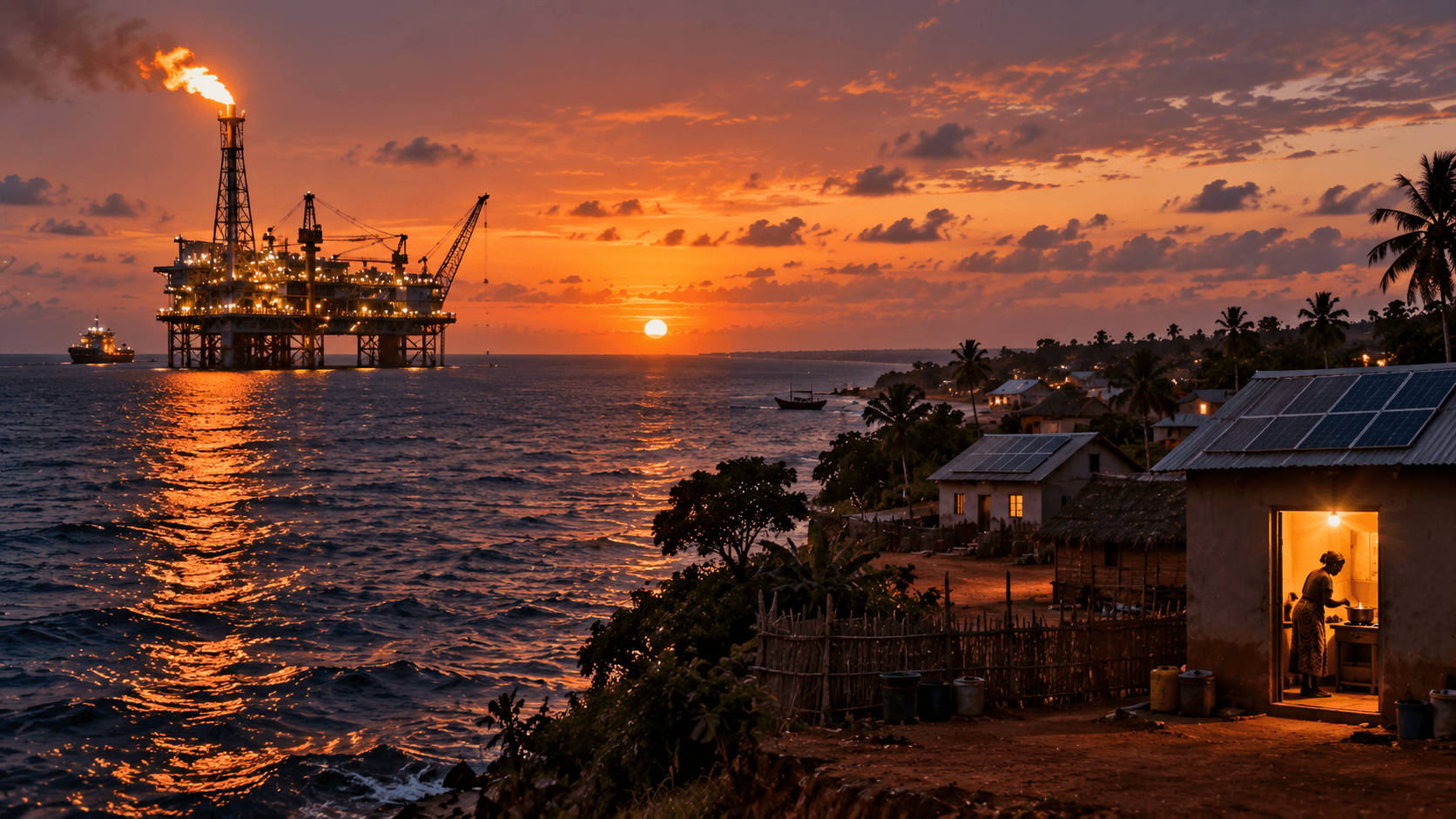
Tanzania is simultaneously pursuing two energy futures that pull in different directions. In one, a $42 billion liquefied natural gas megaproject – led by Equinor, Shell, and ExxonMobil, targeting over 47 trillion cubic feet of offshore reserves – transforms the country into a major global gas exporter, generating fiscal revenues that dwarf anything in Tanzania’s economic history. In the other, 20,000 solar electricity systems reach island communities, 597 hamlets in Mwanza Region alone receive solar installations, and the Rural Energy Agency extends clean power to villages that have waited decades for grid connection. These two visions are not necessarily incompatible – but the governance decisions that determine which gets prioritised, how revenue flows between them, and who bears the environmental and social costs of each, define what Tanzania’s energy future actually means for its 65 million people. Following these decisions with the depth and consistency they require is central to the work of Madini Today – the investigative outlet that covers extractive industries and energy governance in Tanzania with sustained analytical focus that event-driven reporting cannot maintain.
This article examines Tanzania’s energy crossroads in full: the LNG project’s decade-long journey toward a final investment decision, the solar and renewable expansion transforming rural communities right now, the structural relationship between resource extraction revenues and energy access investment, and the accountability gaps that determine whether Tanzania’s extraordinary energy endowment translates into broad-based development or concentrated benefit.
The LNG Project: A Decade of Negotiation, Billions in Potential
The Tanzania LNG project has been described, with some justification, as one of the most consequential infrastructure decisions in sub-Saharan African history. The numbers are genuinely staggering: estimated cost of $42 billion, making it the largest single investment ever planned in Tanzania; reserves of more than 57 trillion cubic feet of offshore natural gas – one of the largest gas discoveries in African history; production capacity targeting two liquefaction trains processing 10 million metric tons per year; and fiscal projections suggesting the project could add an estimated 10% to Tanzania’s GDP and create 8,000 direct jobs upon commissioning.
The project’s history is a case study in the complexity of large-scale extractive investment in a developing country navigating sovereign interests, investor confidence, and geopolitical dynamics simultaneously. Large-scale gas discoveries began in 2010. A consortium including BG Group, Ophir Energy, ExxonMobil, Equinor, Shell, and Pavilion Energy entered discussions about an LNG export terminal near Lindi in 2016. Negotiations over fiscal terms, regulatory arrangements, and commercial agreements extended through successive governments – complicated significantly by the Magufuli administration’s confrontational approach to foreign resource investors from 2017 onward, during which Tanzania suspended talks with foreign investors pending a review of gas production sharing agreements.
Equinor wrote down the book value of its Tanzania LNG project assets by approximately $1 billion in February 2021 – a signal of how seriously the investor community viewed the regulatory disruption. The current administration under President Hassan has pursued a markedly different approach: emphasising predictable fiscal terms, international arbitration acceptance, and streamlined approval processes that contrast with the earlier posture.
In May 2023, Equinor, Shell, and ExxonMobil agreed to a Host Government Agreement framework with the Tanzanian government. Government officials said in January 2026 that the Final Investment Decision would be concluded by June of that year. As of mid-2026, the agreement had not been signed – but the trajectory was the closest the project had come to actual capital commitment in its sixteen-year history. Neighbouring countries including Uganda and Kenya have already signed agreements to purchase Tanzania’s LNG, indicating confidence in eventual project delivery and anticipation of regional energy security benefits.
What the LNG Project Would Actually Mean
The promotional narrative around Tanzania’s LNG project focuses appropriately on its scale – but scale alone does not determine whether a resource project benefits the country that hosts it. The specific fiscal terms, the local content provisions, the community impact frameworks for the Lindi coastal communities near the terminal site, and the governance mechanisms that ensure revenues are collected and deployed transparently are the details that determine developmental outcome.
Tanzania currently produces around 226 million cubic feet of gas per day, supporting approximately 42% of national power production as well as industrial consumers including cement manufacturers, metal fabrication plants, and breweries. Domestic gas use is real and growing. The LNG export terminal is designed primarily to monetise offshore gas for export – a different economic model from prioritising domestic gas use for industrial development and power generation. The tension between export optimisation and domestic development use is one the most consequential fiscal and policy choices Tanzania will make in the project’s design.
The fiscal architecture matters enormously. Gas production sharing agreements determine how revenue is split between the government and the international consortium at different production levels and price points. Stability clauses limit the government’s ability to revise these terms as prices change. Transfer pricing arrangements between consortium members can reduce the taxable profit that Tanzanian authorities see. The experience of other African LNG exporters – Mozambique being the most recent and instructive – is that the fiscal returns to the host government from LNG projects can be substantially below the headline projections if the contract terms are not carefully negotiated and if enforcement capacity is inadequate.
Tanzania’s TPDC (Tanzania Petroleum Development Corporation) holds a 10% participating interest in Equinor’s Block 2. This equity stake – analogous to the 16% free carry in mining operations – gives the state direct participation in production revenue rather than merely royalty and tax flows. But TPDC’s capacity to effectively exercise this participation right – engaging meaningfully with technical and commercial decisions, monitoring production data, and ensuring its interests are protected in operational choices made by the consortium’s majority shareholders – depends on institutional resources and expertise that the corporation is still developing.
The Solar Revolution Happening Right Now
While the LNG project advances through its final negotiation stages, a parallel energy transformation is underway in Tanzania’s rural communities – and it is delivering results now rather than in the 2030s when LNG first exports are projected.
Out of Tanzania’s 143 islands, more than 120 have already been connected to solar power systems under government subsidy programmes covering between 45 and 75% of installation costs. In Mwanza Region bordering Lake Victoria, projects worth TZS 127.7 billion – approximately $55 million – are targeting rural electrification through solar installations, improved cookstove distribution, and solar energy promotion. As of April 2026, 597 out of Mwanza’s 3,448 hamlets had received solar power installations, with contractors engaged to complete remaining connections.
The Rural Energy Agency (REA) is implementing 20,000 solar electricity systems in island areas in the initial phase of a programme targeting communities that have never been connected to Tanzania’s national grid. Tanzania’s national energy plan targets universal electricity access by 2030 – an ambitious goal requiring connection of approximately 14,000 remaining hamlets – and solar is the primary technology pathway for remote and island communities where grid extension is economically impractical.
Tanzania’s solar resource endowment makes this ambition technically achievable. The country receives substantial solar irradiation throughout most of the year, with average daily irradiation of 4 to 7 kilowatt-hours per square metre across most of the country – among the highest in the world for a country of Tanzania’s size. In 2024, Tanzania added over 200 MW of solar capacity, bringing total renewables to around 1.5 GW. The government’s Fifth Development Plan (FYDP IV) envisions renewables powering 97% of primary energy by 2050, with solar as the cornerstone technology.
The transformation in households that receive solar access is documented and significant. Solar home systems provide lighting, phone charging, and small appliance power to households that previously relied on kerosene lamps – expensive, health-damaging, and a persistent fire risk. Health clinics with reliable electricity can operate medical equipment, store vaccines, and provide emergency care at night. Schools with solar lighting extend study hours. Small businesses can refrigerate perishable products and operate equipment after dark. The electrification program has specifically targeted fishing communities around Lake Victoria, providing power for fish processing facilities – a crucial economic activity whose productivity is directly constrained by electricity access.
The Government’s Clean Cooking Agenda
Electricity access is only part of Tanzania’s energy challenge. Cooking energy – the fuel used to prepare food in the three daily meals that define household energy consumption in most Tanzanian households – remains a profound public health and environmental challenge. The majority of Tanzanian households still cook primarily on wood fuel or charcoal, generating indoor air pollution that is the leading environmental health risk for women and children in sub-Saharan Africa, contributing significantly to Tanzania’s deforestation, and releasing carbon emissions that undermine the country’s climate commitments.
The government has committed to ensuring that at least 80% of Tanzanians use clean cooking energy by 2034 – a target that Deputy Minister for Energy Salome Makamba reaffirmed to Parliament in April 2026. The clean cooking agenda encompasses liquefied petroleum gas (LPG) distribution, improved biomass cookstoves that reduce emissions while remaining compatible with wood fuel use, and biogas systems that convert agricultural and animal waste into cooking gas.
Tanzania’s natural gas sector has a potential role in the clean cooking transition: compressed natural gas and LPG derived from gas processing can be distributed through cylinder networks to urban and peri-urban households. The small-scale LNG facility being developed by Energetech Tantel in partnership with TPDC – an investment of up to $100 million initially liquefying 20 to 30 million standard cubic feet per day – represents one pathway for deploying domestic gas production in service of the clean cooking agenda rather than exclusively for export.
The Structural Relationship: How Extractive Revenue Funds Energy Access
The connection between Tanzania’s resource governance and its energy transition is financial as well as technical. The royalties, taxes, and dividends that Tanzania receives from its mining sector – TZS 1.39 trillion in 2025/26, beating government targets by 16% – fund the national budget that supports REA’s rural electrification programme. The LNG project, if it reaches production in the early 2030s, would generate fiscal revenues on a scale that could transform Tanzania’s capacity to invest in energy infrastructure, health systems, education, and agricultural development simultaneously.
This fiscal linkage is the most direct argument for the proposition that resource governance quality determines development outcomes. A mining sector that generates full fiscal revenues – through transparent royalty collection, effective transfer pricing enforcement, and genuine community benefit distribution – provides government with the financial capacity to accelerate energy access investment. A sector where revenues leak through smuggling, underdeclaration, and inadequate fiscal administration delivers less to the national budget and therefore less to the rural electrification programme that depends on it.
Tanzania must increase installed electricity capacity from 4,032 MW to 15,000 MW – a 272% expansion – between 2025 and 2031 under FYDP IV targets. The country’s entire generation infrastructure took several decades to reach 4,000 MW. Achieving this expansion in six years requires capital mobilisation on a scale that no single revenue source can provide – it requires the simultaneous deployment of extractive revenues, development finance, private investment, and international climate finance in a coordinated framework that Tanzania’s energy planning is attempting to build.
The Tanzania-Zambia Interconnector and Regional Energy Integration
Tanzania’s energy strategy extends beyond its borders through regional integration initiatives that have direct implications for how its resource wealth is deployed. The Tanzania-Zambia Interconnector, projected for completion in 2026, will connect Tanzania to renewable energy resources across Eastern and Southern Africa – enabling electricity trade, supporting industrialisation in southwestern Tanzania, and creating a contiguous transmission corridor from Southern Africa through Zambia into Ethiopia, Kenya, and Tanzania.
Regional electricity trade benefits Tanzania in two directions: it provides a market for surplus electricity generation during high-hydro periods, and it provides backup supply during drought years when hydropower production falls. Tanzania’s hydroelectric capacity – currently the dominant component of its generation mix at approximately 60% of total renewables – is highly vulnerable to the rainfall variability that climate change is intensifying. Interconnection with diverse regional power sources reduces this vulnerability significantly.
The geopolitical dimension of energy integration is also relevant. Uganda and Kenya purchasing stakes in Tanzania’s LNG output represents energy security cooperation that strengthens Tanzania’s regional relationships. The East African Community’s broader energy integration agenda – shared grids, harmonised tariffs, cross-border renewable projects – positions Tanzania as a potential regional energy hub whose significance extends well beyond its domestic consumption needs.
Accountability Gaps in Tanzania’s Energy Transition
Tanzania’s energy governance faces accountability gaps analogous to those documented in its mineral sector. The same information asymmetries, contract opacity, and enforcement limitations that characterise mining governance also affect energy project governance – and in the case of the LNG project, the scale of the investment makes the stakes of governance failure proportionally larger.
The LNG Host Government Agreement – the document that will govern the fiscal and regulatory terms under which $42 billion of infrastructure is built and the resulting revenue is distributed – has not been publicly disclosed. Its terms will determine what share of LNG revenues Tanzania receives, under what conditions, with what stability protections for investors and what adjustment rights for the government, and what community benefit obligations apply to the coastal communities in Lindi Region whose land and livelihoods will be most directly affected by terminal construction and operation. These are questions of profound public interest – and the precedent of TEITI’s failure to disclose full mining contract texts, despite formal commitments to do so, suggests that the LNG agreement may face the same transparency deficit.
The rural electrification programme faces different accountability questions. REA’s implementation record – which hamlets have received connections, what the service quality is, what the ongoing maintenance model is, and whether the subsidy programmes are reaching the most remote and economically vulnerable communities – is documented in government reports but not in the real-time, community-accessible format that would allow meaningful local accountability. Solar home systems that fail without available spare parts or trained maintenance personnel revert communities to kerosene within months of installation – a failure mode that project-level reporting frequently obscures.
Women’s participation and benefit in the solar energy sector deserves specific attention. Research on rural solar enterprises in Tanzania has found that most are male-owned, marginalising women’s participation and benefit despite women bearing the highest burden of inadequate cooking energy – through indoor air pollution exposure, time spent collecting firewood, and the health consequences of smoke inhalation. Energy access programmes that do not specifically address women’s ownership and benefit in the solar economy risk replicating the gender equity failures of the conventional energy sector in the renewable transition.
The 2030 Universal Access Goal: What Would Actually Achieving It Require?
Tanzania’s goal of universal electricity access by 2030 is ambitious enough to warrant examining what achieving it would actually require – not as an exercise in scepticism but as a practical planning question.
Connecting 14,000 remaining hamlets in four years requires an implementation pace several times faster than anything Tanzania has previously achieved. It requires contractor capacity, supply chains for solar equipment, trained installation and maintenance workforce, and community engagement processes that do not currently exist at the required scale. It requires financing that exceeds the Rural Energy Agency’s current budget allocation. And it requires a policy environment that prioritises access for the hardest-to-reach communities rather than the most cost-effective connections – a political economy challenge that universal access programmes consistently confront.
The financing dimension is where the connection between resource governance and energy access is most direct. Tanzania’s FYDP IV energy sector targets require capital mobilisation that the domestic budget alone cannot provide. International climate finance – through mechanisms including the Green Climate Fund, bilateral clean energy partnerships, and concessional development finance – is an essential complement to domestic resource revenue. Tanzania’s credibility as a climate finance recipient depends partly on the governance quality of its energy and resource sector – the transparency of contracts, the enforcement of environmental standards, and the accountability mechanisms that demonstrate responsible resource management.
What Tanzania’s Energy Future Actually Depends On
Tanzania’s energy crossroads is ultimately a governance crossroads. The country has the resource endowment – offshore gas, solar irradiation, hydroelectric potential, geothermal prospects – to achieve both LNG export revenues and universal clean energy access. What determines whether both ambitions are realised, or whether one comes at the expense of the other, is the quality of the decisions made about fiscal terms, contract transparency, community benefit, environmental accountability, and the distribution of revenues between export optimisation and domestic development investment.
The LNG project’s fiscal terms will determine how much of the $42 billion in investment value Tanzania captures for its development priorities versus how much flows to the international consortium’s shareholders. The rural electrification programme’s implementation quality will determine whether solar access translates into genuine economic development or merely physical installation statistics. The clean cooking transition’s gender dimensions will determine whether the energy transformation improves the lives of the women who bear the highest burden of energy poverty or primarily serves male-headed commercial interests. And the accountability journalism that investigates all of these dimensions – documenting gaps between official claims and operational reality, tracking fiscal flows from resource to service, and amplifying the voices of communities most affected by energy governance decisions – is the oversight function that formal institutions in Tanzania’s energy sector have not yet consistently provided.
Frequently Asked Questions
What is the Tanzania LNG project and what is its current status?
The Tanzania LNG project is a proposed $42 billion liquefied natural gas export terminal near Lindi on Tanzania’s southern coast, targeting development of more than 47 trillion cubic feet of offshore natural gas. The consortium is led by Equinor and Shell, with participation from ExxonMobil, Pavilion Energy, Medco Energi, and state-owned TPDC. After more than a decade of exploration and negotiation – including a suspension of talks during the Magufuli era and a $1 billion Equinor write-down in 2021 – the project reached a Host Government Agreement framework in May 2023. Government officials targeted a Final Investment Decision by June 2026. As of mid-2026, the agreement had not been signed but the project was closer to capital commitment than at any previous point in its history.
How much natural gas does Tanzania have?
Tanzania has discovered more than 57 trillion cubic feet of offshore natural gas, primarily in deep-water blocks in the Indian Ocean off the southern coast. This makes it one of the largest gas discoveries in African history. Currently, Tanzania produces around 226 million cubic feet per day, supporting approximately 42% of national power production and various industrial consumers. The LNG export project would monetise a significant portion of the offshore reserves for international markets while domestic production continues to serve power generation and industrial needs.
What progress has Tanzania made on rural electrification through solar?
Tanzania has made significant progress on rural solar electrification in 2025 and 2026. More than 120 of Tanzania’s 143 islands have been connected to solar power under government subsidy programmes covering 45 to 75% of installation costs. In Mwanza Region, 597 out of 3,448 hamlets received solar installations as of April 2026, with contractors engaged for remaining connections. The Rural Energy Agency is implementing 20,000 solar systems in island areas in the first phase of a broader programme. Tanzania added over 200 MW of solar capacity in 2024, with the government targeting 97% renewable primary energy by 2050 and universal electricity access by 2030.
What is Tanzania’s clean cooking energy target?
Tanzania’s government has committed to ensuring at least 80% of Tanzanians use clean cooking energy by 2034. Deputy Minister for Energy Salome Makamba reaffirmed this target to Parliament in April 2026. The clean cooking agenda encompasses LPG distribution, improved biomass cookstoves, and biogas systems. The majority of Tanzanian households still cook primarily on wood fuel or charcoal, generating indoor air pollution that is a leading public health risk, contributing to deforestation, and releasing carbon emissions. Tanzania’s natural gas sector – including the small-scale LNG facility being developed by Energetech Tantel with TPDC – has potential to support clean cooking transition through LPG and compressed natural gas distribution.
How does resource revenue connect to Tanzania’s energy access goals?
The royalties, taxes, and dividends Tanzania receives from its mining sector – TZS 1.39 trillion in 2025/26 – fund the national budget that supports rural electrification programmes. The LNG project, if it reaches production in the early 2030s, could generate fiscal revenues on a scale that would transform Tanzania’s capacity to invest in energy infrastructure simultaneously with health, education, and agricultural development. This fiscal linkage means that resource governance quality – transparent royalty collection, effective transfer pricing enforcement, anti-smuggling enforcement – directly affects the government’s capacity to fund energy access investment. A resource sector generating full fiscal revenues provides more for rural electrification than one where revenues leak through governance failures.
What accountability gaps exist in Tanzania’s energy governance?
The LNG Host Government Agreement – the document governing fiscal and regulatory terms for the $42 billion investment – has not been publicly disclosed, limiting independent evaluation of whether Tanzania is negotiating adequate terms. Tanzania’s EITI implementation gap on contract disclosure in the mineral sector creates concern that the same opacity may apply to energy sector agreements. The rural electrification programme’s implementation record – which communities are being reached, service quality, and maintenance models – is documented in government reports but not in real-time, community-accessible formats that enable local accountability. Women’s participation in the solar economy is limited despite women bearing the highest burden of energy poverty, creating a gender equity gap in the clean energy transition.
What is the Tanzania-Zambia Interconnector and why does it matter?
The Tanzania-Zambia Interconnector is a cross-border electricity transmission project projected for completion in 2026 that will connect Tanzania to renewable energy resources across Eastern and Southern Africa. It will enable electricity trade, support industrialisation in southwestern Tanzania, reduce Tanzania’s vulnerability to the hydropower production variability caused by rainfall variability and climate change, and create a contiguous transmission corridor from Southern Africa through Zambia into Ethiopia, Kenya, and Tanzania. Regional electricity integration is a component of Tanzania’s broader energy strategy that complements both the LNG export ambition and the domestic renewable expansion.
What is Tanzania’s electricity generation capacity and what does FYDP IV require?
Tanzania currently has approximately 4,032 MW of installed electricity generation capacity, with hydropower dominating at roughly 60% of the renewables mix and solar growing rapidly to approximately 25%. Tanzania’s Fifth Development Plan (FYDP IV, 2026/27–2030/31) requires expanding installed capacity to 15,000 MW – a 272% increase – within six years. The country’s entire generation infrastructure took several decades to reach 4,000 MW. Achieving this expansion requires the simultaneous deployment of extractive revenues, development finance, private investment, and international climate finance in a coordinated framework. Rural electrification access currently stands below 36%, with supply reliability under 50 to 60% in rural zones – the baseline conditions against which the universal access by 2030 target must be assessed.